A P&ID on the wall cannot tell you what happens next.
Twenty-two refinery units, each one a live drawing. Hover a vessel and it says what it does and what it takes with it when it fails. Trace a system and the rest of the sheet dims. Walk a real failure step by step, with the alarms it raises on the board.
Built by OEG for the trainers who have three weeks to get a new operator ready - and for the operator who has to run the unit at three in the morning.
The unit is documented. The way it behaves is not.
Every refinery has drawings, procedures and a training folder. What none of them hold is the part a competent operator carries in their head: what moves when one thing fails.
{{ p.h }}
{{ p.t }}
Time to competency, incident exposure and senior-engineer hours all come out of the same account. That is the account this series is written against.
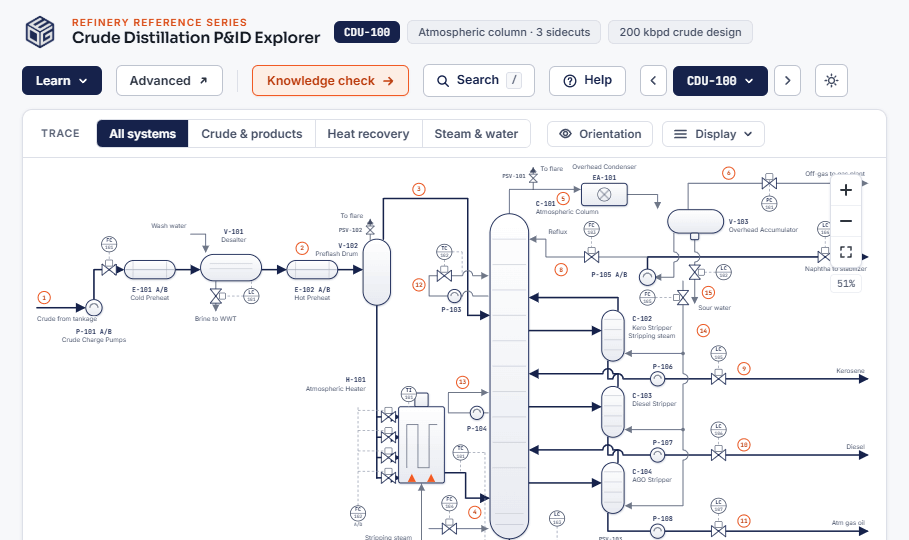
One page per unit, and the page is the drawing.
ISA symbols, real tag numbers, hairline instrument signals - a sheet an engineer recognises and a new hire can interrogate. Nothing asks the reader to correlate a diagram with a paragraph three pages later.
Five ways to ask the drawing a question, all of them on every unit:
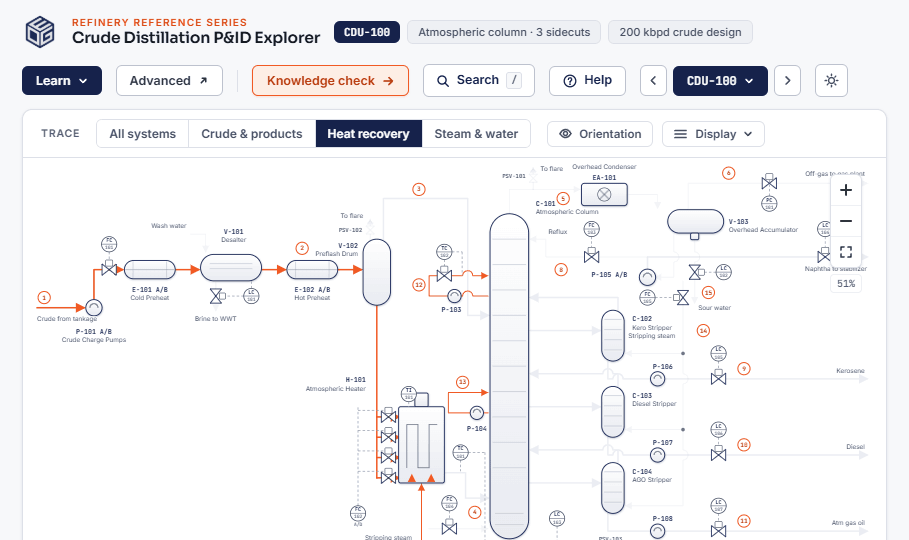
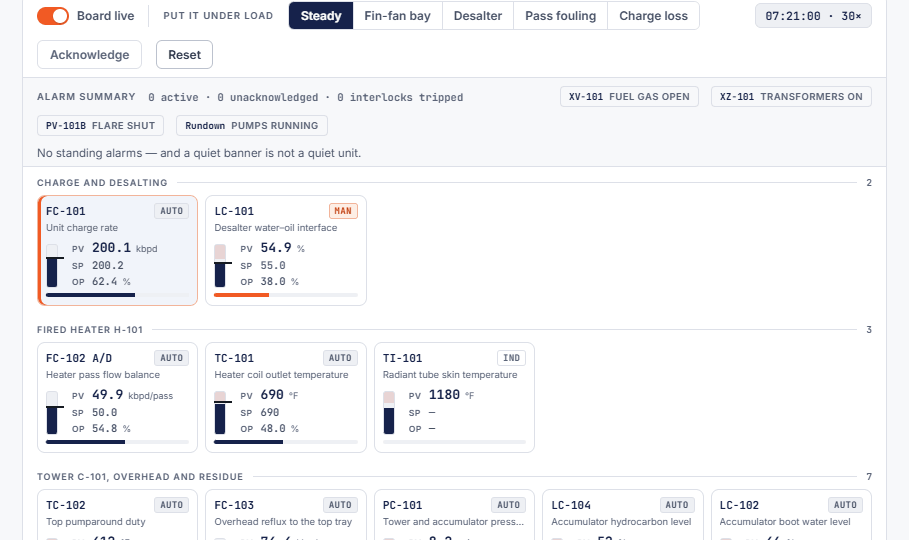
Every reading on the sheet is the one an operator would act on: what sets it, what it holds, and which way it moves before an alarm arrives. The teaching is in the consequence, not in the label.
P-101, the charge pump, just tripped.
Feed flow dies and FC-101 rings LOW-LOW. Step forward and the failure moves through the preheat train, the heater and the tower in the order the board would see it - with the operator's move at every step. Six of these ship on CDU-100 alone; 106 across the series.
Walk it on the live sheet →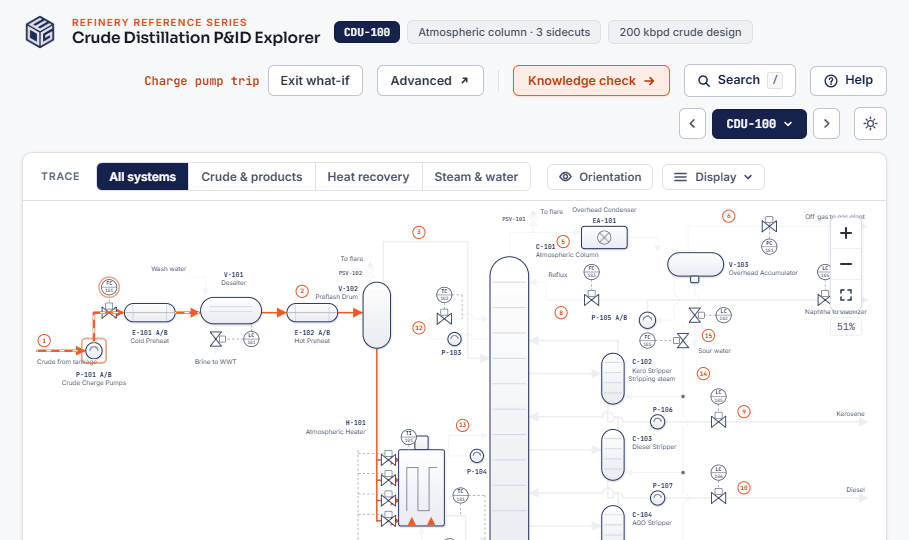
The sheet is not the only way in.
Two more tools sit on the CDU-100 page. One puts the reader in the unit; the other takes the sheet away and asks them to draw it.
Crude Distillation, open end to end.
Cuts 200 kbpd of crude into naphtha, kerosene, diesel and atmospheric residue. No reboiler anywhere on the unit - every drop of vapour in that tower comes from the fired heater and the stripping steam, which is exactly why it is the unit we hand people first.
The other 21 units are catalogued below and ship with the library. Seven advanced modules - the operator round, the console, the procedures - are in build on top of this same unit.
A check per unit, marked against the drawing.
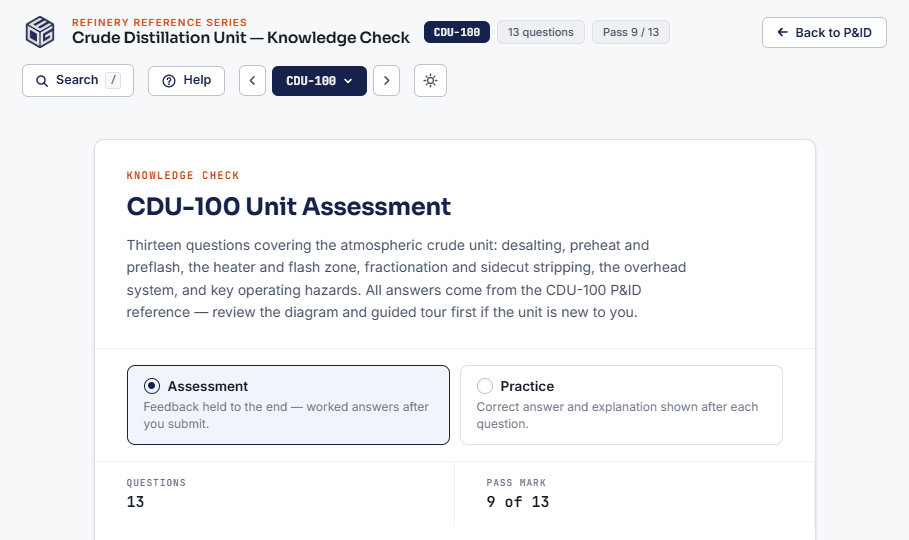
423 questions across 22 checks, each with a pass mark set for that unit. Four kinds, and the last one is the kind trainers ask for by name.
Every question links back to the exact vessel, loop, stream or scenario it came from, so a review session is spent on the drawing rather than on the answer key.
Past the drawing: seven tools that put the reader on shift.
The P&ID teaches the unit. These teach the job - the round, the board, the procedure, and the reasoning between an alarm and an action. In build now on CDU-100, releasing per unit.
A whole refinery, crude through blending.
Including the utilities, relief, sulfur and effluent systems that most training libraries leave out - the ones every unit leans on and nobody teaches. Every stream that leaves one sheet lands on another; this is the map that holds them together.
Twenty-two units from crude receipt to blending, joined by 40 numbered inter-unit streams. The map ships with the library and traces plant-wide systems - hydrocarbon, hydrogen, sulfur, relief - the same way the unit pages do.
Fits the way your people already train.
Deliver it through the OEG Knowledge Library, or hand it to the learning management system you already run. Either way it is a browser page, with nothing to install on a plant desktop.
{{ d.h }}
{{ d.t }}
{{ s.h }}
{{ s.t }}
Walk one unit with your own experts in the room.
Tell us which unit your next turnaround or new-hire class is about. We will open that page with your people, take their redlines, and show you how the check is marked.
See the P&ID Explorer in action
Request a demo or ask about licensing
A live walkthrough of the units your crews actually run. Name the unit your next turnaround or new-hire class is built around and we will open that sheet with your people in the room.
- Address
- 10235 West Little York Road, Suite 260
Houston, TX 77040 USA - Phone
- +1 281.794.9107
- sales@oegllc.com